Free checkers answer the simple question well: does this passport need a visa for that country. For a solo traveler with a strong passport, free is enough.
Pay when the situation gets complicated. Mixed-nationality families need per-passport answers in one view. Groups need batch tracking. Frequent travelers need expiry reminders and a history of past applications.
The feature that decides it, though, is the lookup itself. A generic country page gives one answer per destination. A passport visa requirement lookup tool gives one answer per passport and destination pair, and those answers diverge far more than most travelers expect.
Fifteen destinations each, 13 different answers
We ran the comparison on this site's own database: 13 passports, each recorded against 15 destinations of its own, 195 records in total. The results split the passports into two different worlds.
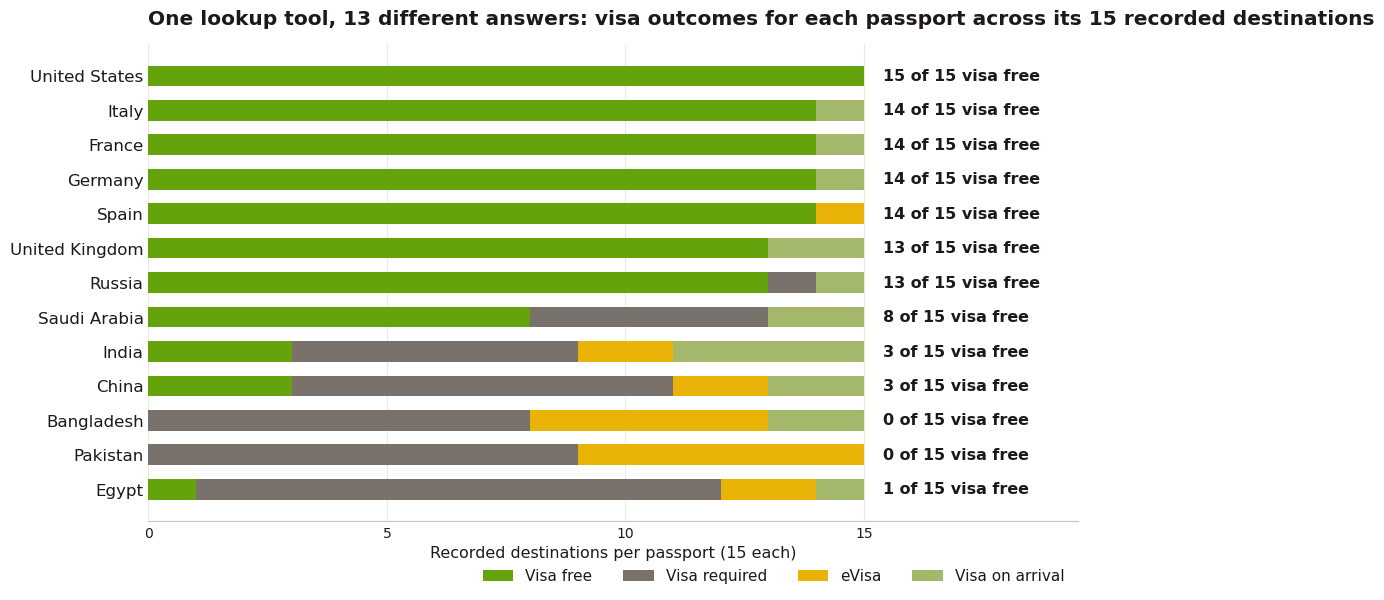
Source: eVisaPreparation database, 195 records, Oct 2026 snapshot. Each passport is recorded against 15 destinations; segments show how its 15 routes split by requirement type. Rules change; confirm against official sources before you book.
At the top, the United States passport is visa free on 15 of 15 routes, and the Italian, French, German and Spanish passports are visa free on 14. At the bottom, the Pakistani and Bangladeshi passports are visa free on none of the 15: Pakistan splits between 9 visas required in advance and 6 eVisas, and an Egyptian passport needs a visa before travel on 11 of its 15 routes. A free checker that answers for the average passport is wrong, in one direction or the other, for most of the table.

That is what the paid tier has to prove it does: read your row, not the destination's reputation. If the tool cannot show different answers for different passports on the same route, it is a country page with a paywall.
The price test still applies
The price test: a paid checker costs less than one visa fee. India's e-visa is $25, Turkey's about $50, Schengen's 90 euros. If the app prevents one wrong application, it paid for itself several times over. The database above is the reason wrong applications happen: the traveler read a page written for a stronger passport, or for last year's rule.
Do not pay for a checker that only shows generic country pages. Pay for one that knows your passport, your trip dates, and your group, and gives answers specific to all three. Start with this site's passport visa requirement lookup to see your own row, and check any connection in the Transit Visa Checker before you book around it.
There is a two-minute test that exposes a generic checker. Look up a destination with a strong passport, then run the identical search with a weaker one. In this database, the United Kingdom route reads visa free for a United States passport and visa required for a Pakistani one. Thailand reads visa free at 30 days for nine passports and eVisa for three others. If the tool returns the same answer both times, it is not looking anyone up; it is reciting the destination page.
Even the strong passports have exceptions worth paying to catch. The Russian passport, visa free on 13 of its 15 recorded routes, still has one route that requires a visa in advance. The Saudi passport splits 8 visa free, 5 required, and 2 on arrival. A lookup that rounds those rows up to "mostly visa free" is how a traveler ends up at a check-in desk with the wrong paperwork for the one route that was different.
The honest summary is that free and paid checkers differ less in their data than in their shape. Free tools publish pages. A lookup tool answers pairs, one passport and one destination at a time, and keeps the note attached to the answer. Pay for the shape, not the promise, and test it with two passports before you trust it with a trip.
The same logic applies to the notes attached to each answer. Just over half the routes in the database, 101 of 195, carry a condition or exception on top of the headline rule. A checker that shows the rule without the note has done the easy half of the lookup.
Sources: U.S. State Department, IATA Travel Centre